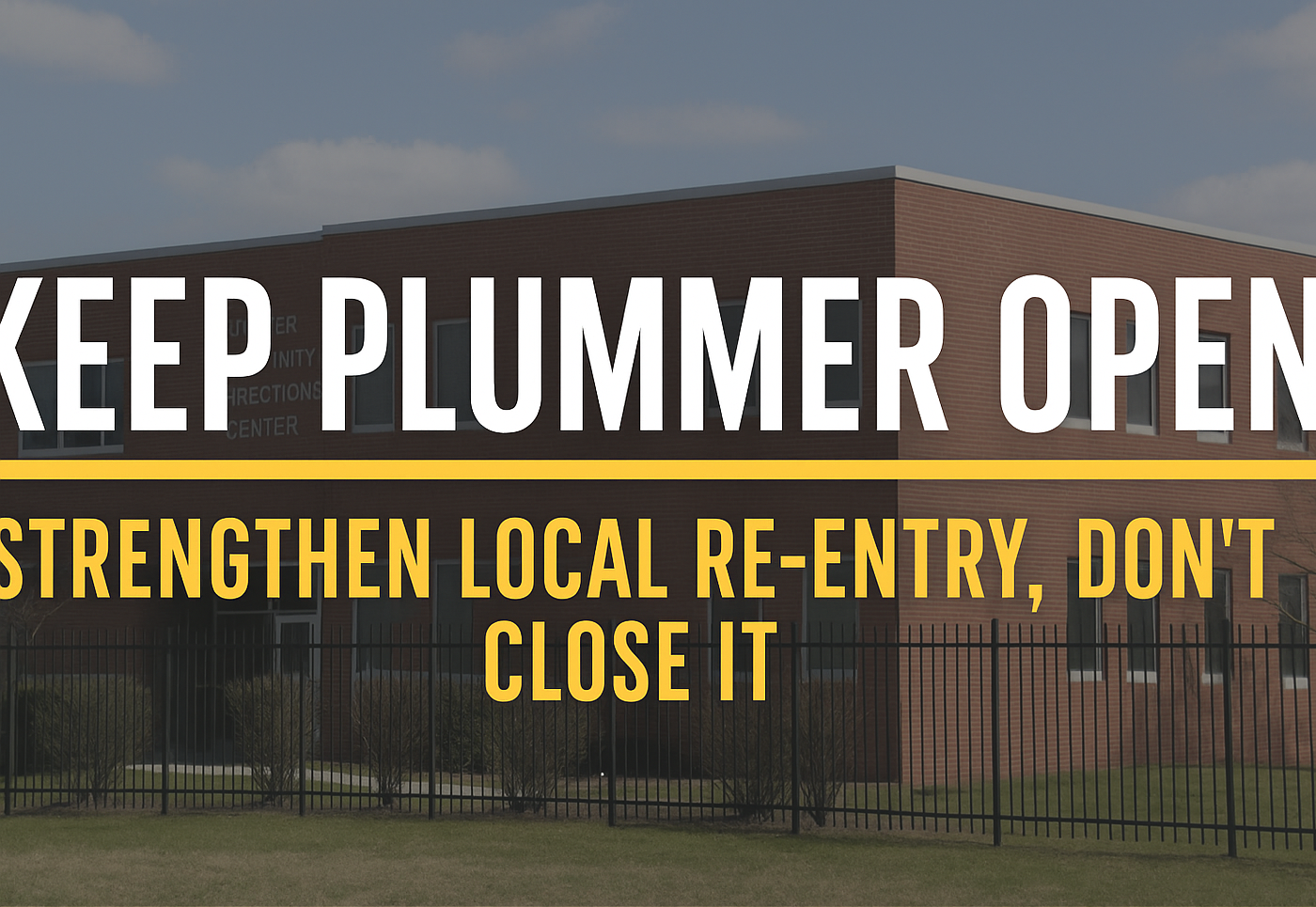
KEEP PLUMMER OPEN!
Strengthen Local Re-Entry in Wilmington

The conversation is two-fold:
Keep the Plummer Community Corrections Center in the City of Wilmington
Make work release more impactful so returning Wilmington residents have housing, mental health support, and a real career pathway
No decision is permanent or irreversible. Wilmington families deserve transparency, data, and solutions that actually improve public safety.
Take Action!
-
Sign the Community Letter
Add your name to a growing call from Wilmington residents demanding transparency, data, and real re-entry solutions. This letter tells state leaders that closing Plummer without community input is unacceptable.
-

Organizations: Sign-On Letter
Join local and statewide organizations standing together to protect Wilmington-based re-entry. Signing on shows collective power and shared commitment to housing, stability, and public safety rooted in community.
Call DOC (Kate): 302-739-5601
A brief call makes a real impact. Ask the Department of Correction to pause the closure, release the data, and commit to Wilmington-based solutions for people returning home.

The Impact on Wilmington Families
Plummer is Wilmington’s only Level IV community-based re-entry center. People return to Wilmington, not Sussex.
Distance and isolation do not create safety - successful transitions do.

-
Why the State Says It Wants to Close Plummer
State officials have offered a few primary reasons for closing the Plummer Center:
-
1. “Plummer is under capacity.”
The State says Plummer has not been operating at full capacity since COVID.
What’s missing:
There has been no public explanation of why placements were reduced, no data showing a reduced need for Level IV re-entry, and no plan to restore or improve utilization. Under-use is a management issue - not a justification for closure.
-
2. “Fewer people need Level IV due to probation and sentencing changes.”
The State argues judges are sending more people directly to probation or home confinement.
What’s missing:
There is no data showing that re-entry needs have declined. Housing insecurity, unemployment, mental health needs, and substance use challenges have increased. Many people returning home still need structured support - especially those without stable housing.
-
3. “It’s more cost-effective to consolidate in Kent or Sussex.”
The State suggests closing Plummer saves money by consolidating operations downstate.
What’s missing:
No line-item budget, no cost comparison, and no accounting for:
* transportation costs
* lost employment opportunities
* increased instability
* higher recidivism risk
* added strain on Wilmington shelters and services
Cost-saving claims have not been supported with evidence.
-
4. “Re-entry outcomes won’t be harmed.”
The State has implied that transferring people downstate will not negatively impact re-entry.
What’s missing:
There is no data supporting this claim. National research consistently shows that proximity to home, family, and employment improves re-entry outcomes.

Why These Reasons Don’t Add Up
If Plummer is under-utilized, the answer is revitalization - not closure.
If work release is not effective, the answer is fix the program - not eliminate the facility.
If cost is the concern, the State must show the data and compare real outcomes - not shift people farther away from support.

Why Plummer Matters
Keeping Plummer open supports:
Family connection and accountability
Employment access in the local job market
Transportation and service continuity
Lower recidivism through stability

Why Sussex Isn’t the Answer
Sussex is far from Wilmington families and the job market, and many low-income Black Wilmington residents experience Sussex as culturally hostile and unwelcoming. Distance undermines rehabilitation and increases instability.
This Is About Housing, Mental Health, and Career Transition
Re-entry works when it’s intentional.
A common-sense approach:
Housing:
Verified address → House arrest (Level IV)
No address → Remain in Wilmington with Wilmington-based Level IV options
Mental Health:
Trauma-informed care
Counseling
Peer support
Career Transition:
Real pathways, not short-term labor

What We Are Asking For
Pause the closure of the Plummer Center
Return Wilmington residents to Plummer
Public community listening sessions in Wilmington
Release all data used to justify closure
Full DOC budget audit, including fleet and facility use
Transparency around welfare funds and commissary revenue
Revitalize work release in Wilmington with a clear strategy
People over profit.
Community resources over prisons.

Community Listening Session
Save the Date: January 14
A community-led listening session to document impacts and present solutions.
Details coming soon.
FAQ: The Plummer Center & Re-Entry in Wilmington
-
Plummer is Wilmington’s only Level IV community-based re-entry center. It connects returning residents to family, employment, transportation, and services - all critical to reducing recidivism and increasing public safety.
-
Most people returning home are coming back to Wilmington. Sending them two counties away:
breaks family connections
limits job opportunities
creates transportation barriers
increases isolation and instability
Distance makes re-entry harder, not safer.
-
Plummer has been underutilized since COVID - but that is due to placement decisions, not reduced need. Underuse is a reason to improve and revitalize the program, not shut it down.
-
For some people, yes.
For others, no.
If someone has a verified address: house arrest (Level IV) should be used.
If someone does not have housing: they need a Wilmington-based Level IV option like Plummer.
Most returning residents do not have stable housing.
-
No. This is about being smart on re-entry.
People who return home with housing, mental health support, and employment pathways are less likely to return to prison and more likely to stabilize their families and neighborhoods.
That is public safety.
-
The State has not released a line-item budget or cost comparison. There is no public data showing this saves money once transportation, job loss, homelessness, and recidivism are considered.
-
A common-sense re-entry strategy:
Keep Plummer open in Wilmington
Revitalize work release
Partner with local employers
Use house arrest when appropriate
Address housing and mental health needs
-
Sign the community letter
Organizations: sign on to the coalition letter
Call DOC leadership
Attend the community listening session on January 14
Final Word
People who don’t live in your house shouldn’t make decisions about your house.
“Decisions about Wilmington must be made with Wilmington - using data, transparency, and lived experience.”